
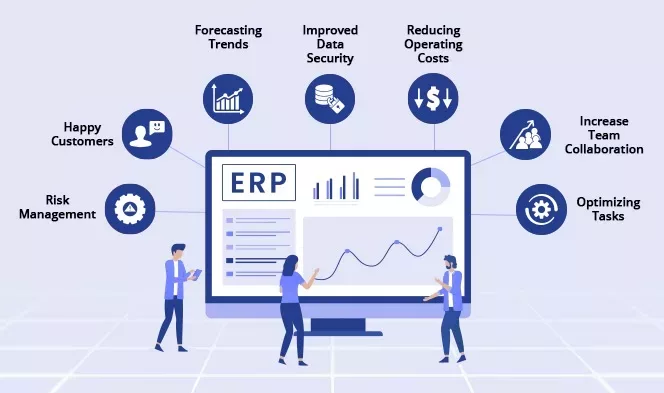
In today’s competitive business environment, managing different departments, processes, employees, customers, inventory, finances, and daily operations can become increasingly challenging. Businesses often use multiple software applications and spreadsheets to manage different activities, which can result in duplicated data, communication gaps, manual work, and reporting difficulties.
This is where Enterprise Resource Planning (ERP) software can make a significant difference.
ERP software provides businesses with a centralized platform where different business processes can be managed, monitored, and connected. Instead of maintaining separate systems for different departments, organizations can use an integrated ERP solution to bring important operations together.
At Chandra Software Technologies, we provide customized software development solutions designed around the specific requirements of businesses. Our goal is to help organizations use technology to simplify operations, improve productivity, reduce manual processes, and make better business decisions.
What Is ERP Software?
Enterprise Resource Planning, commonly known as ERP, is a business management software system that integrates multiple organizational processes into a single platform.
Depending on the company’s requirements, an ERP system can include modules for:
- Finance and accounting
- Human resource management
- Customer relationship management
- Sales management
- Purchase management
- Inventory management
- Order management
- Project management
- Employee management
- Payroll management
- Reporting and analytics
- Vendor management
- Business operations
The exact modules required depend on the type, size, and objectives of the business.
A customized ERP solution allows businesses to select and integrate the functionality they actually need instead of paying for unnecessary features.
Why Do Businesses Need ERP Software?
As a business grows, its operations become more complex. Managing everything manually may work for a small organization, but it can become difficult when the number of employees, customers, products, transactions, and departments increases.
For example, a company may maintain customer information in one system, inventory in an Excel spreadsheet, accounting information in another application, and employee information somewhere else.
This creates several challenges.
Employees may need to enter the same information multiple times. Managers may struggle to get real-time information. Departments may work with different versions of the same data. Generating reports can also require significant manual effort.
ERP software addresses these challenges by connecting business processes through a centralized system.
1. Centralized Business Data
One of the biggest advantages of ERP software is centralized data management.
Instead of storing business information across multiple disconnected systems, an ERP platform can provide a centralized database where authorized users can access relevant information.
For example, when a sales order is created, the information can potentially be connected with inventory, customer records, invoicing, and reporting.
This reduces unnecessary data duplication and helps different departments work with consistent information.
2. Improved Business Productivity
Manual administrative work can consume a significant amount of employee time.
Employees may spend hours entering data, preparing reports, checking spreadsheets, updating records, and communicating information between departments.
ERP software can automate many repetitive processes.
For example, automated workflows can help with:
- Order processing
- Invoice generation
- Inventory updates
- Employee records
- Purchase management
- Customer management
- Notifications
- Reporting
By reducing repetitive tasks, employees can spend more time on productive activities that contribute directly to business growth.
3. Better Inventory Management
Inventory management is critical for businesses that sell or manufacture products.
Poor inventory management can lead to overstocking, stock shortages, inaccurate records, and unnecessary costs.
An ERP system can help businesses maintain better control over inventory by providing information about stock levels, product movement, purchases, sales, and warehouse operations.
Businesses can use this information to make better purchasing and inventory decisions.
For organizations with multiple warehouses or locations, ERP software can also provide centralized visibility across different inventory locations.
4. Streamlined Sales and Customer Management
An ERP system can integrate sales activities with customer information and other business processes.
Sales teams can access customer records, order history, quotations, invoices, and other relevant information from a centralized platform.
This can improve customer service because employees do not need to search through multiple systems to understand a customer’s history.
ERP systems can also work alongside CRM functionality to help businesses manage leads, customer interactions, sales opportunities, and follow-ups.
5. Improved Financial Management
Financial management is another important area where ERP software can provide significant value.
An ERP platform can help businesses manage invoices, payments, expenses, purchases, and other financial information in a centralized environment.
Instead of manually collecting financial data from different departments, management can access organized information through the ERP system.
Depending on the implementation, businesses can also generate financial reports and monitor important financial metrics more efficiently.
6. Human Resource and Employee Management
Managing employees manually can become complicated as an organization grows.
ERP software can include HR-related functionality for managing employee information, attendance, leave, payroll, departments, roles, and other employee-related processes.
A centralized employee management system can help HR teams reduce paperwork and maintain accurate employee records.
It can also provide employees and managers with controlled access to relevant information through dedicated dashboards or portals.
7. Real-Time Reporting and Analytics
Business decisions are often based on accurate and timely information.
If managers have to wait for different departments to prepare spreadsheets and reports, decision-making can become slow.
ERP software can provide centralized reporting and dashboards that allow management to monitor business activities more efficiently.
Depending on the ERP system, dashboards may display information such as:
- Sales performance
- Revenue
- Expenses
- Inventory levels
- Pending orders
- Customer information
- Employee data
- Purchase activity
- Business performance
Access to organized information can help management identify problems and opportunities more quickly.
8. Automation of Business Processes
Automation is one of the key reasons businesses invest in ERP systems.
Instead of requiring employees to manually perform every step of a process, an ERP system can automate predefined workflows.
For example, a purchase request could move through a defined approval process. Once approved, the system could generate or update the relevant purchase information.
Similarly, sales and inventory workflows can be connected so that information is automatically updated when transactions occur.
Automation helps reduce manual effort and can also minimize the possibility of human errors.
9. Better Collaboration Between Departments
Departments often need to share information with one another.
Sales may need inventory information. Finance may need sales and purchase information. HR may need employee information from different departments. Management may need information from almost every area of the organization.
Without an integrated system, this communication can become complicated.
ERP software connects departments through a common platform, making it easier for authorized users to access the information they need.
This can improve collaboration and reduce communication gaps.
10. Scalable Business Management
A good ERP system should be able to grow with the business.
As the organization expands, it may need additional employees, locations, products, customers, warehouses, or business processes.
A scalable ERP solution can be expanded to accommodate changing requirements.
This is particularly important for growing businesses because replacing an entire system every time the business expands can be expensive and disruptive.
Why Choose Custom ERP Development?
Every business has its own processes and requirements.
Ready-made ERP solutions can provide many useful features, but they may not always perfectly match a company’s workflow. Businesses may end up changing their processes to fit the software.
Custom ERP development provides another approach.
A customized ERP system can be designed around the organization’s specific workflow, departments, users, approval processes, reporting requirements, and business objectives.
At Chandra Software Technologies, we focus on developing customized software solutions that align with individual business requirements.
Our team can help businesses plan and develop ERP solutions with the modules and functionality they need.
ERP Development by Chandra Software Technologies
At Chandra Software Technologies, we understand that implementing ERP software is not simply about developing an application. It is about understanding how a business operates and converting those processes into an effective digital system.
Our software development services can help businesses develop customized ERP solutions for different operational requirements.
Depending on the project, an ERP solution can include modules such as:
Admin Management: Manage users, roles, permissions, and system settings.
HR Management: Maintain employee records, departments, attendance, leave, and other HR information.
CRM: Manage customers, leads, communication, and customer-related activities.
Sales Management: Manage quotations, orders, customers, invoices, and sales activities.
Purchase Management: Manage suppliers, purchase orders, and procurement processes.
Inventory Management: Monitor products, stock levels, warehouses, and inventory movement.
Accounting: Manage financial records, transactions, invoices, expenses, and reports.
Reports & Analytics: Generate business reports and dashboards for better decision-making.
The final ERP architecture can be customized according to the organization’s requirements.
Choosing the Right ERP Development Partner
ERP development is a long-term business investment, so choosing the right technology partner is important.
Businesses should consider factors such as customization capabilities, scalability, security, usability, integration requirements, support, and overall development cost.
A reliable development partner should first understand the business processes before recommending or developing an ERP solution.
At Chandra Software Technologies, our approach is focused on understanding business requirements and creating technology solutions that provide practical value.
Conclusion
ERP software can transform the way businesses manage their daily operations. By connecting departments, centralizing data, automating repetitive processes, improving reporting, and providing better visibility, ERP systems can help organizations operate more efficiently.
From inventory and sales to HR, finance, purchasing, customer management, and reporting, a well-designed ERP system can bring important business processes together under one platform.
For businesses looking for a solution that matches their unique workflow, custom ERP development can provide greater flexibility and scalability.
Chandra Software Technologies helps businesses turn their operational requirements into customized software solutions designed to improve efficiency and support long-term digital growth.
If your business is planning to develop a customized ERP system or wants to automate its existing business processes, our team can help you explore the right technology solution for your requirements.
Contact Chandra Software Technologies
Phone: +91 821 848 8224
Email: chandermtr@gmail.com
Address: 2A/638, Krishna Vihar, BSA Engineering College Rd, Mathura, Uttar Pradesh 281001
Chandra Software Technologies — Building smarter software solutions for modern businesses.